Loading
Manufacturing Consultant · Manufacturing SEO Blog
How Can My Company Appear in ChatGPT & AI Recommendations?
Tarun Gurwara's AI consulting for manufacturing helps factories appear in ChatGPT, Gemini & Perplexity recommendations with AEO and schema strategy.
By Tarun Gurwara, Manufacturing Growth Consultant & Creator of Digifacturing. Published by Manufacturing Consultant, Ahmedabad, Gujarat. About Tarun →
Quick Answer
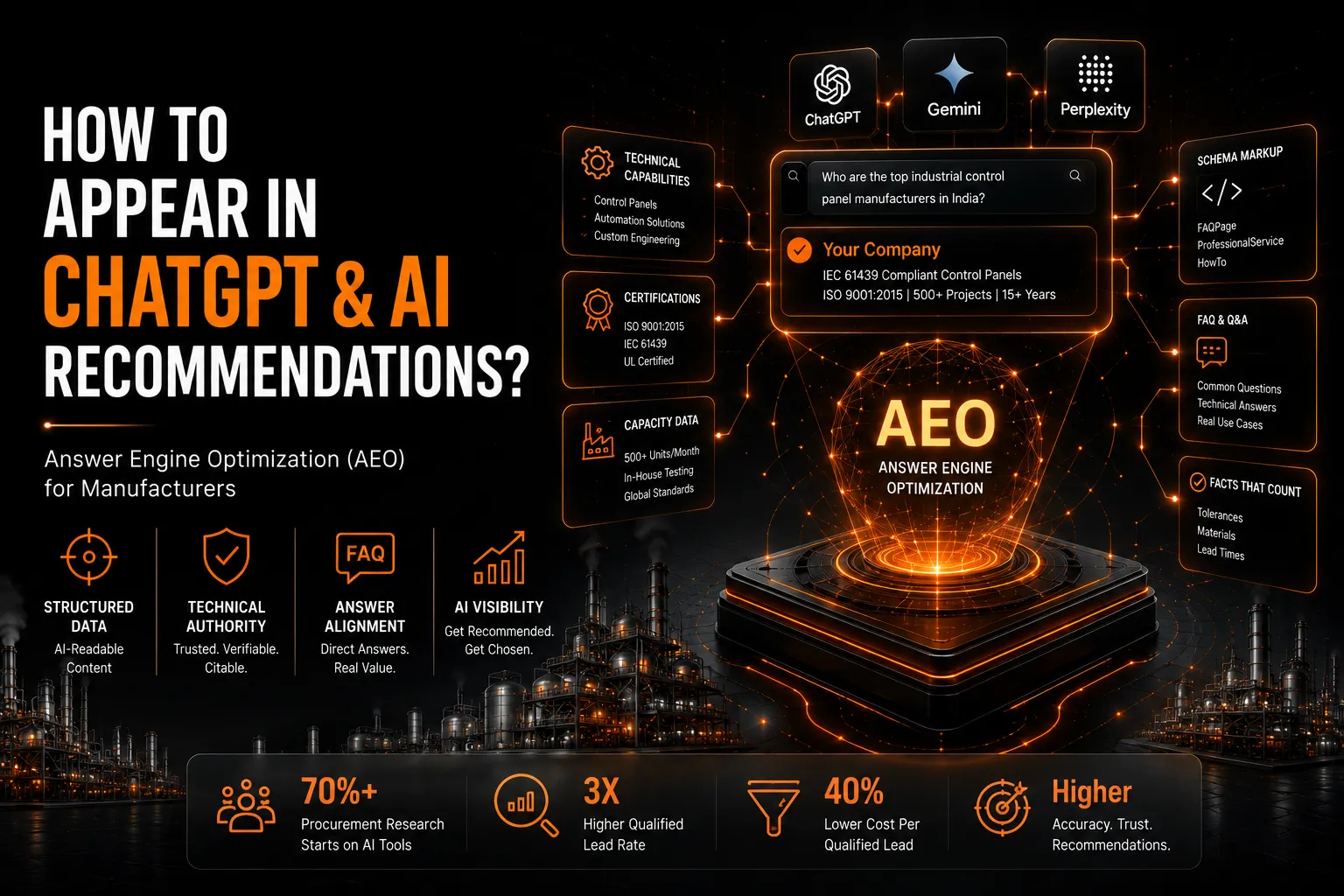
To appear in ChatGPT, Gemini, and Perplexity recommendations, your website needs to function as a structured data source, not a marketing brochure. AI tools answer procurement questions by querying entity data, structured schema, and verifiable technical facts, not by browsing pages the way a human does. Manufacturers get recommended when their site clearly anchors their brand to specific technical capabilities, backs every claim with measurable specs instead of marketing language, and implements schema markup that gives AI systems a direct, unambiguous summary of what they do. This is the core of modern AI marketing for manufacturing and a critical part of manufacturing digital transformation.
Get a Free AEO AuditThe Shift from Search Engines to Answer Engines
For two decades, manufacturing companies optimized for one outcome: ranking high enough in Google search to get clicked. In 2026, a growing share of procurement research starts inside an AI assistant instead. When a procurement manager asks ChatGPT or Perplexity who the top manufacturers are for a given category, the AI is not browsing ten blue links — it is querying a knowledge graph built from structured, fact-dense sources and synthesizing a direct answer.
In traditional SEO, you compete for a click. In Answer Engine Optimization, you compete to be the source the AI trusts enough to cite. If you are not structured in a way the AI can parse confidently, it will recommend a competitor instead, even if your actual shop-floor capabilities are stronger. This is exactly why factory owners searching for the best digital marketing consultant for manufacturing company, a manufacturing digital transformation consultant near me, or an industrial SEO agency are turning to specialized partners instead of general digital agencies.
Your website's job is no longer just to convince a human visitor. It now also has to convince an AI system, in milliseconds, that you are a verifiable, well-defined entity in a specific manufacturing category.
Why This Matters More for Manufacturing Than Most Industries
Industrial buying decisions are technical and high-stakes by nature. A wrong supplier choice can mean failed parts, missed certifications, or a blown production schedule, which makes procurement teams unusually likely to use AI tools as a first-pass filter before they ever pick up the phone. They check public data: certifications, tolerances, capacity, and materials. Manufacturers who get AEO right have an outsized advantage over those who do not.
This is also why many manufacturers asking why their company is not getting online enquiries, or how to get more B2B leads for their manufacturing company, discover that the root problem is not traffic volume, but the complete absence of AI-readable structure.
If your site does not state your tolerances, certifications, and capacity in a structured, extractable way, an AI system has no factual basis to recommend you. Regardless of how good your actual shop floor is.
Why Manufacturers Lose AI Visibility
After auditing multiple manufacturing sites for AI readiness, we consistently find the same three gaps:
1
Sites Built to Convince Humans, Not AI Systems
Your website's job is no longer just to convince a human visitor. It now also has to convince an AI system, in milliseconds, that you are a verifiable, well-defined entity in a specific manufacturing category — and most manufacturing sites are only built for the first job.
2
Good Writing Without Schema
Most manufacturing websites write good, accurate content but never wrap it in schema. A page with mediocre writing but excellent schema will often outperform a page with excellent writing and no schema on AI citation rate.
3
Marketing Superlatives With No Verifiable Backing
Words like 'best,' 'leading,' or 'number one' are unverifiable claims an AI system has no way to confirm, so it tends to discount or ignore them entirely when deciding who to recommend.
The 4 Pillars of AI Visibility (AEO)
To be recommended by an LLM, your content must satisfy its requirement for high-authority entity validation. These four pillars work together — missing even one weakens the others:
01
Pillar 1: Entity Anchoring
We explicitly associate your brand with specific manufacturing niches rather than broad, vague positioning — replacing language like 'we manufacture industrial equipment' with specific claims like 'we manufacture IEC 61439-compliant low-voltage switchgear panels' that an AI can confidently map to a real query. This anchoring needs to be consistent across your site: homepage, service pages, and case studies should all reinforce the same specific entity definitions.
02
Pillar 2: Structured Data (Schema) Authority
We implement Organization, ProfessionalService, HowTo, and FAQPage schema so AI systems get a structured cheat sheet of your capabilities, location, and expertise instead of needing to infer or guess from prose alone. This is where most manufacturing websites lose visibility without realizing it: they write good, accurate content but never wrap it in schema. Read more on Why Manufacturers Don't Show Up on Google →
03
Pillar 3: Objective Technical Grounding
We replace unverifiable superlatives like 'best' or 'leading' with measurable specs — tolerances, production capacity, and certifications. Instead of 'we offer top-tier machining,' use '5-axis CNC machining with tolerances down to ±0.005 mm.' A number, a standard, or a certification is something an AI model can match against a buyer's stated requirement; a superlative cannot.
04
Pillar 4: Semantic Q&A Alignment
We design content as a direct response to the actual questions procurement teams ask AI tools, pairing FAQPage schema with prose answers so the AI knows exactly which text answers which question. When you answer these questions clearly, specifically, and with verifiable detail, you become the source of truth the AI cites. See also Can AI Generate Leads for Manufacturing Companies? →
Putting the 4 Pillars Into Practice: A Working Checklist
| Pillar | What to Check | Common Mistake |
|---|---|---|
| Entity Anchoring | Is your specific manufacturing niche stated consistently across all pages? | Generic "industrial equipment" language with no specific niche |
| Schema Authority | Does every capability or FAQ page carry matching JSON-LD? | Schema "described" in content but never actually implemented in code |
| Technical Grounding | Are claims backed by numbers, standards, or certifications? | Superlatives like "best" or "leading" with no measurable backing |
| Q&A Alignment | Does content directly answer real procurement questions? | Content written only for SEO keywords, not for actual buyer questions |
How This Connects to Lead Generation, Not Just Visibility
Appearing in an AI recommendation is only valuable if the traffic that follows converts. A site structured for AEO using the four pillars above is, almost by definition, also a better-qualified lead funnel. The same data — certifications, tolerances, capacity, MOQ — that helps an AI system recommend you is exactly the data a serious procurement buyer needs to self-qualify before contacting you.
Manufacturers who build AEO and B2B lead generation as one integrated system, rather than two separate projects, get more out of both. This integrated approach is the foundation of the Digifacturing methodology.
Signs Your Site Has an AI Visibility Problem
You likely have a gap if: your capability pages use general phrases like "industrial equipment" instead of named standards and processes, none of your pages carry FAQPage or ProfessionalService schema, your claims lean on words like "best" or "leading" without a number attached, and you've never checked whether ChatGPT or Perplexity can accurately describe what you make. If several of these sound familiar, start with Why Manufacturers Don't Show Up on Google →.
How Manufacturing Consultant Helps You Get Recommended
We audit entity anchoring and consistency across your pages, close schema implementation gaps, rewrite technical claims to replace superlatives with measurable specs, and align your FAQ content to the actual questions procurement teams ask AI tools.
Our objective is not simply appearing more often. Our objective is being the verifiable, well-defined entity the AI trusts enough to cite.
Get a Free AEO AuditWant to Know Where You Stand on AI Visibility?
Connect with Tarun Gurwara on WhatsApp and book a free 30-minute AEO audit of your manufacturing website.
Frequently Asked Questions
EntityCommercial
What is Answer Engine Optimization (AEO)?
AEO is the practice of structuring your website's content and data so that AI systems like ChatGPT, Gemini, and Perplexity can confidently extract, understand, and cite your business when answering a user's question.
Entity
Do I need to remove all marketing language from my website?
Not entirely, but claims that influence AI recommendations should be backed by verifiable facts. Capability claims should be paired with specific, measurable details.
EntityCommercial
Which schema types matter most for manufacturers?
Organization or ProfessionalService schema for overall business identity, FAQPage schema for question-and-answer content, and HowTo schema for process-explanation content.
Commercial
How long does it take to see results from AEO improvements?
Manufacturers who implement schema and entity anchoring consistently tend to see citation improvements within a few months, though this varies by domain authority.
Entity
Can I do AEO and traditional SEO at the same time?
Yes, they are complementary. Most of the technical grounding, schema, and Q&A alignment work that improves AEO also improves traditional search rankings.
EntityCommercial
Should I hire an agency or do digital marketing in-house for AEO?
For complex technical manufacturing products, partnering with a specialized manufacturing business growth consultant or industrial marketing agency almost always outperforms a general digital agency or pure in-house team.
Be the Cited Source
Get Recommended by ChatGPT & AI Tools
Book a free 30-minute AEO audit with Tarun Gurwara and find out exactly what's stopping AI systems from citing your company.
Ahmedabad, Gujarat, India · Digifacturing · Tarun Gurwara