Loading
Institutional Growth · Enrollment Content Strategy
Content Strategy That Converts Prospect Students into Applications
Modern prospective students and their parents approach university admissions with the same analytical scrutiny as enterprise B2B buyers evaluating massive industrial investments. Broad banner advertising, generic campus brochures, and unsegmented email blasts no longer produce qualified application volumes. Converting passive inquiries into completed enrollments requires an entity-driven, full-funnel content architecture. As a digital growth consultant specializing in institutional scaling across universities, multi-specialty hospitals, and industrial manufacturing enterprises, Tarun Gurwara engineers precision-targeted enrollment funnels that reduce cost-per-application while maximizing student qualification rates.
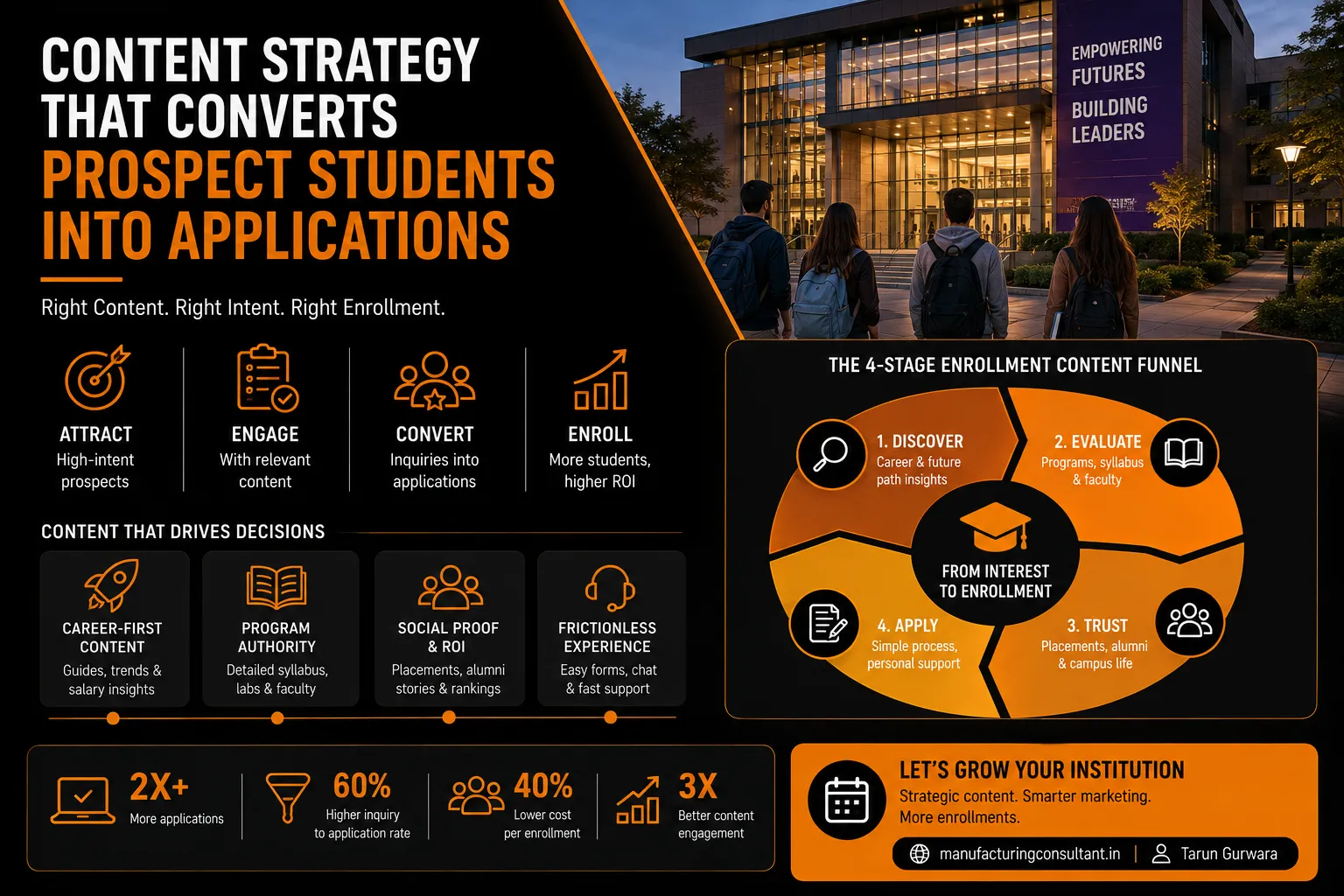
01. The 4-Stage Student Enrollment Content Funnel
Rather than pushing for immediate form submissions on cold traffic, a high-converting content ecosystem nurtures prospective students through four distinct decision phases: Discovery & Career Intent, Program & Curriculum Evaluation, Peer & Institutional Validation, and Frictionless Application.
Top of Funnel (TOFU): Career-First & Specialization Content
Prospective students rarely start by searching for a specific university name; they search for future career paths, emerging specializations, and industry opportunities. Actionable assets include comprehensive career trajectory guides, salary outlook reports for emerging engineering or management streams, and comparison analyses between traditional degrees and industry-integrated specializations, optimized around high-volume, problem-solving informational queries to capture early intent before competitors enter the consideration set.
Middle of Funnel (MOFU): Program Depth & Faculty Authority
Once a student identifies a target field, they evaluate academic rigor and infrastructure. Actionable assets include programmatic course landing pages featuring detailed syllabus breakdowns, virtual lab tours, faculty research credentials, and hands-on industry project overviews, with structured course schemas embedded to ensure search engines and AI answer engines index program durations, prerequisites, and credential accreditations directly in search results.
Bottom of Funnel (BOFU): ROI, Placements & Social Proof
At the application decision point, students and parents evaluate return on investment and campus credibility. Actionable assets include granular placement reports by department, unscripted alumni video case studies, recruiter testimonials from Tier-1 corporate partners, and clear scholarship qualification criteria, backed by interactive fee calculators, eligibility checkers, and transparent admission deadline trackers that provide clear calls to action.
Post-Inquiry Retention: Automated Nurture Sequences
A lead is not an enrollment until fees are submitted. Actionable assets include multi-channel WhatsApp and email nurture sequences delivering department-specific news, campus life insights, and direct Q&A invites with academic counselors.
02. Cross-Sector Pipeline Framework
The underlying architecture of high-intent digital acquisition remains consistent across complex, high-consideration sectors:
Higher Education / Universities
Primary conversion goal is a verified student application. The core buyer concern is placement ROI and accreditation. The key content asset is program syllabi and alumni outcomes. Search engine focus centers on programmatic course SEO.
Multi-Specialty Hospitals
Primary conversion goal is a specialized patient appointment. The core buyer concern is clinical outcome and specialist trust. The key content asset is doctor credentials and treatment guides. Search engine focus centers on hyper-local medical and specialty SEO.
Industrial Manufacturing
Primary conversion goal is a direct industrial RFQ submission. The core buyer concern is technical tolerance and supply reliability. The key content asset is CAD drawings, certifications, and plant walkthroughs. Search engine focus centers on high-intent B2B and export buyer marketing.
Schedule an Institutional Growth Consultation
Upgrade your university's digital acquisition engine, reduce reliance on third-party aggregators, and build a predictable, high-yield student enrollment pipeline.
Frequently Asked Questions
Commercial
How does content strategy directly increase university application rates?
Generic promotional copy creates skepticism. A structured content strategy answers critical student questions regarding curriculum relevance, faculty expertise, placement statistics, and campus infrastructure. By addressing hesitation points early in the research phase, prospect drop-off is minimized, leading to higher form completions and verified fee-paid applications.
Entity
How can universities leverage AI and structured data to improve admissions?
By implementing structured JSON-LD schemas (such as CollegeOrUniversity, Course, and FAQPage), universities ensure that their program prerequisites, application deadlines, and fee structures are accurately read and displayed by search engines and AI discovery engines, capturing high-intent student searches at the zero-click stage.
Commercial
Why should higher education institutions adopt B2B industrial pipeline strategies?
University admissions, hospital patient acquisitions, and manufacturing RFQs all involve high financial investment, long deliberation cycles, and multiple decision-makers (students, parents, counselors). Applying disciplined B2B lead qualification frameworks eliminates vanity metrics and focuses marketing spend strictly on pipeline conversion.
Core Focus: Higher Education Institutions · Multi-Specialty Healthcare Networks · Industrial Manufacturing Enterprises
Ready to Build a High-Yield Enrollment Pipeline?
Book an operational strategy session to audit your university's current admissions funnel, evaluate programmatic search visibility, and implement a high-converting content architecture.
Ahmedabad, Gujarat, India · Institutional Growth · Tarun Gurwara