Loading
Healthcare Growth · Complete Guide
Digital Marketing for Hospitals in India: Complete Guide to Patient Acquisition
The landscape of healthcare discovery in India has fundamentally shifted. A significant portion of patients now prefer online platforms for booking appointments and researching healthcare providers before making a decision. For multi-specialty hospitals, clinical networks, and specialized treatment centers, relying solely on legacy referral networks or offline hoardings is no longer sufficient to sustain growth. As a growth consultant specializing in institutional scaling, Tarun Gurwara implements high-intent patient acquisition systems that respect stringent medical ethics while maximizing clinical capacity.
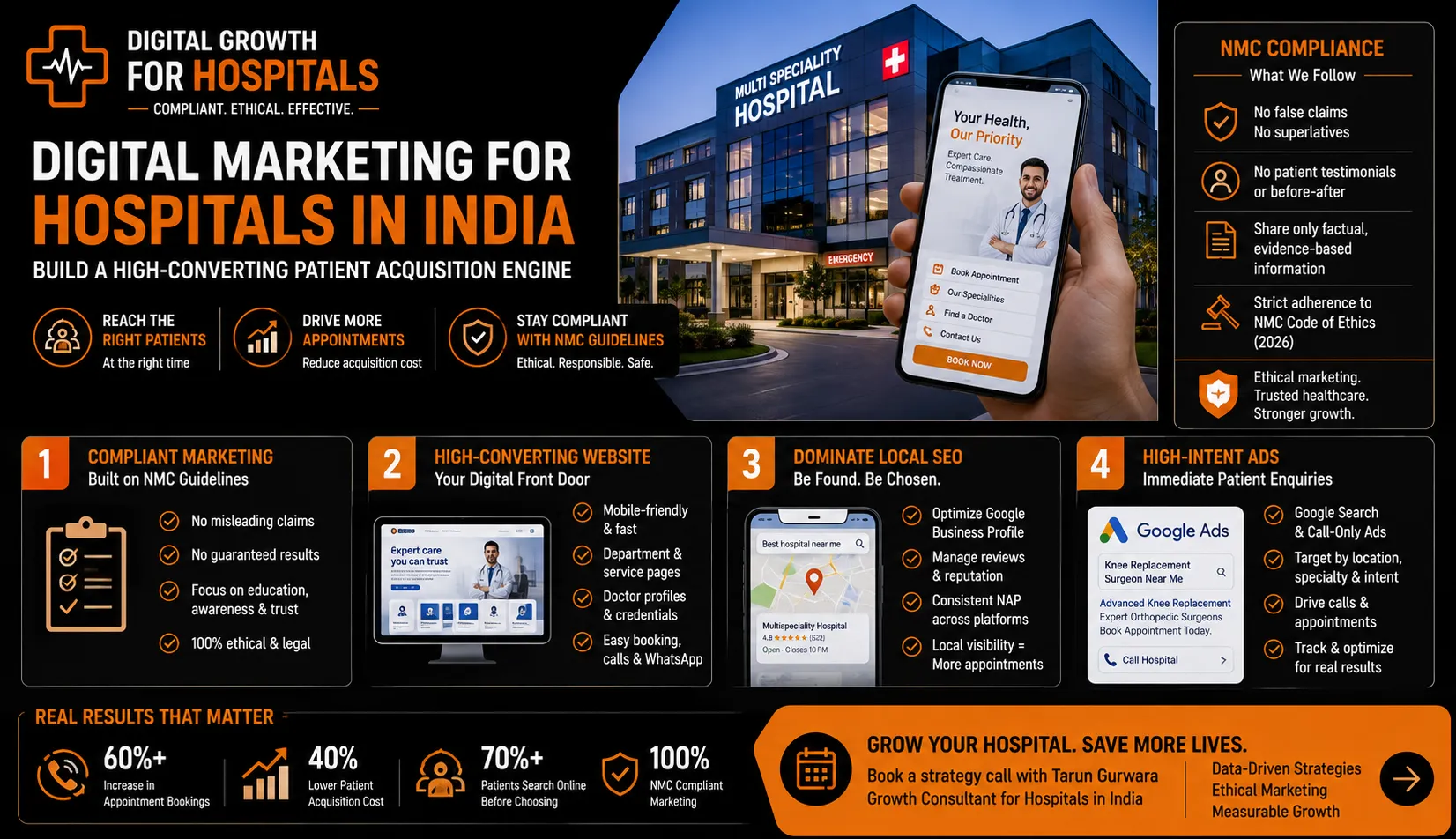
01. The Regulatory Framework: Navigating NMC Guidelines
In India, healthcare digital marketing is not just about driving traffic, it requires strict adherence to regulatory standards. The National Medical Commission Code of Professional Ethics, with its 2026 revision explicitly covering digital channels like Google Ads, Meta Ads, and YouTube, forms the foundation of compliant marketing.
Prohibited Actions
—Superlatives such as "No. 1" or "Best"
—Guaranteed outcome claims (e.g., "100% cure")
—Patient testimonials presented as proof of superior skill
—Advertising cures for restricted conditions, which falls under criminal liability per the Drugs and Magic Remedies Act, 1954
Permitted Actions
—Verifiable doctor credentials
—Factual service descriptions
—Educational content about health conditions
—Accurate directory profiles
02. Building the Digital Front Door: The Hospital Website
A hospital website is the primary digital identity for the institution. Patients judge credibility within seconds of landing on a page, making a fast, mobile-responsive, and accessible design critical.
Department & Service Pages
Individual, structured pages outlining treatments, cost factors, and recovery processes.
Doctor Profiles
Verified doctor credentials, expertise, and professional photos, as anonymity reduces trust in healthcare.
Frictionless Conversion
Clear click-to-call buttons, WhatsApp chat integrations, and easy online appointment booking options. A well-structured website can reduce bounce rates by up to 40% and nearly double appointment conversions.
03. Dominating Local SEO & Google Business Profile
Local SEO remains the strongest long-term digital marketing channel for hospitals. When patients experience an emergency or seek a specialized consultation, they perform high-intent local searches. To capture this demand, hospitals must optimize their Google Business Profile and local footprint:
Consistent NAP
Maintain accurate Name, Address, and Phone number information across the website, Google Business Profile, and all medical directories.
Active Review Management
Positive patient reviews can increase appointment bookings by up to 60%. Hospitals should encourage genuine reviews and address negative feedback calmly, moving patient conversations offline without sharing health details publicly.
Visual Trust
Upload fresh, high-quality photos of the facility and medical team monthly to drive engagement.
04. High-Intent Patient Acquisition via Google Ads
While SEO builds long-term authority, Google Ads generate immediate appointments. Effective paid campaigns for hospitals require precise targeting to avoid wasted ad spend.
Search Ads
Target high-intent queries related to specific treatments and specialties (e.g., "knee replacement surgeon").
Call-Only Campaigns
Deploy mobile-specific ads to capture urgent care inquiries and direct them instantly to the hospital's reception or emergency desk.
Compliance Checks
Ad copy must address patient concerns factually (cost, safety, experience) rather than making generic or misleading claims, which can lead to account suspension under Google's healthcare policies.
05. Content & Video Marketing for Clinical Authority
Patients seek clarity and assurance before undergoing medical procedures. Content marketing and video SEO establish a hospital's doctors as thought leaders while capturing informational search queries.
Educational Content
Publish informational blogs, preventive care guides, and FAQs addressing common patient concerns.
YouTube Optimization
Short-form and long-form videos continue to outperform static content for building trust. Create doctor explanation videos, procedure walkthroughs, and facility tours to improve brand recall.
Schedule a Growth Consultation
Modernize your hospital's digital infrastructure, ensure full regulatory compliance, and build a predictable engine for specialized patient acquisition. Book an operational strategy session to audit your current digital visibility and construct an actionable roadmap for sustained institutional growth.
Frequently Asked Questions
Commercial
Can doctors and hospitals run Google Ads in India?
Yes, with limits. Doctors and clinics can run Google Ads targeting specific service categories and treatments. However, the ad copy must adhere strictly to NMC guidelines by avoiding superlatives, guaranteed cures, or misleading claims.
Entity
How important are online reviews for hospitals?
Extremely important. Managing online reputation builds trust, and positive reviews can increase appointment bookings by up to 60%. Hospitals must establish a system to collect genuine feedback and professionally respond to all reviews.
Entity
What is the role of WhatsApp in hospital marketing?
WhatsApp is a vital communication tool for healthcare providers in India. It facilitates instant appointment booking, automated reminders, report follow-ups, and seamless two-way communication, significantly improving patient convenience and reducing no-shows.
Specialization: Industrial Manufacturing · Defense Supply Chains · Healthcare Infrastructure · Higher Education
Ready to Build a Compliant Patient Acquisition Engine?
Set a meeting with Tarun Gurwara to audit your hospital's current digital visibility and local search performance, and build an actionable growth roadmap.
Ahmedabad, Gujarat, India · Healthcare Growth · Tarun Gurwara