Loading
Healthcare Growth · Performance Marketing Guide
Performance Marketing for Hospitals: Leads vs Brand Awareness
In the healthcare sector, hospital administrators and clinical directors consistently face a critical marketing dilemma: should the budget be allocated toward broad brand awareness or targeted performance marketing? Healthcare is not an impulse purchase; patients do not opt for a knee replacement simply because they saw an attractive Facebook ad. They seek medical care when a specific, urgent need arises. As a digital growth consultant specializing in high-stakes institutional scaling, Tarun Gurwara shifts hospitals away from vanity metrics and toward rigorous performance marketing architectures that directly measure ROI through verified appointments and clinical admissions.
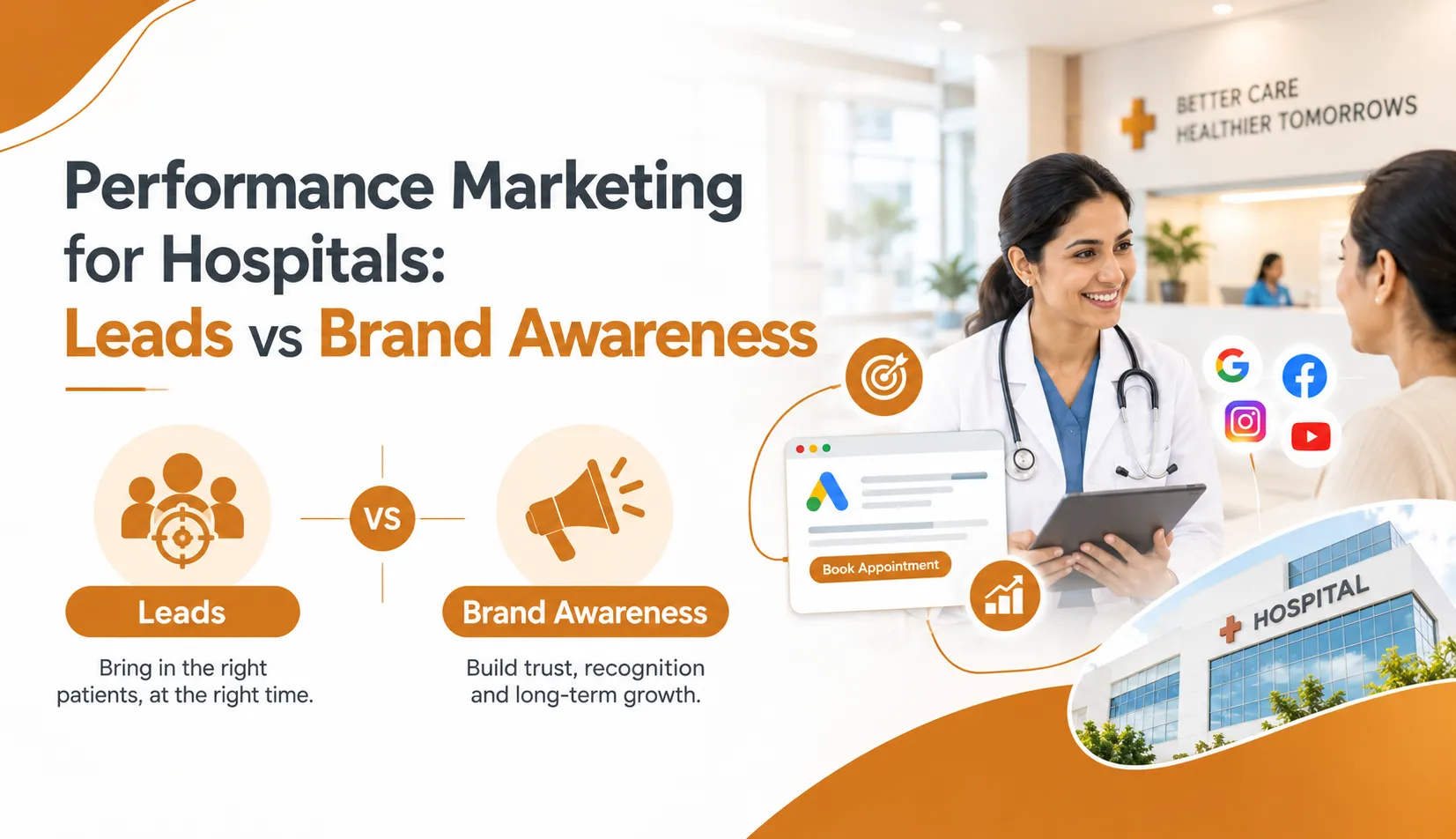
01. Brand Awareness vs. Performance Marketing in Healthcare
To understand why traditional marketing often fails to fill specialist calendars, we must distinguish between passive awareness and active intent.
The Brand Awareness Trap (Passive)
Brand awareness campaigns focus on reach, impressions, and social media engagement. While this might keep the hospital's name in the public eye, it operates on the hope that when a user eventually gets sick, they will remember the logo. It is nearly impossible to track the direct ROI of a billboard or a viral social media post in terms of actual patient footfall, and the budget is spent regardless of whether a single appointment is booked. This approach targets broad demographics through social media branding and display ads, prioritizes impressions, likes, and reach as its primary goal, and leaves ROI measurement anecdotal or estimated at best.
The Performance Marketing Engine (Active)
Performance marketing is entirely transactional and measurable. It targets patients at the exact moment they are actively searching for a solution to their medical problem, such as searching Google for a pediatric cardiologist or the cost of cataract surgery. You only pay when a specific action is taken, such as a click, a website visit, or a submitted appointment form, which focuses budget exclusively on high-intent prospects and radically lowers the cost-per-acquisition. This approach targets high-intent searchers through high-intent Google Ads, local SEO, and conversion pages, with verified leads and booked appointments as the primary goal, and an exact cost per patient acquisition as the ROI measurement.
02. 4 Pillars of a Hospital Performance Marketing Pipeline
Transitioning a hospital from a branding-first approach to a lead-generation powerhouse requires a structured digital framework.
High-Intent Search Architecture (PPC & SEO)
Patients with immediate medical needs bypass social media and go straight to search engines. A performance strategy captures this demand through highly targeted Google Ads and medical SEO. Actionable step: stop bidding on broad terms like "best hospital." Shift budget to hyper-specific, condition-based queries such as "robotic knee replacement cost" or "IVF specialist consultation."
Department-Specific Conversion Funnels
Sending paid traffic to a generic hospital homepage guarantees a high bounce rate. A patient looking for oncology services does not want to navigate past maternity ward updates. Actionable step: build dedicated, fast-loading landing pages for every specialty. These pages must feature verified doctor credentials, clear treatment information, and frictionless booking forms that adhere to medical advertising regulations.
Frictionless Lead Capture & Pre-Qualification
A lead is useless if it sits in an inbox for 24 hours. Performance marketing requires immediate action. Actionable step: integrate direct WhatsApp API routing and automated callback scheduling. When a patient submits a high-intent inquiry for a specialized surgery, the clinical coordination team should receive the data instantly to facilitate immediate contact.
Data-Driven Attribution
Performance marketing removes the guesswork from hospital administration. Actionable step: implement end-to-end tracking using advanced CRM integrations. Track exactly which keyword, ad, and landing page generated a specific patient admission, allowing clinical directors to double down on the most profitable digital assets.
Schedule a Growth Consultation
Stop wasting your healthcare marketing budget on untrackable vanity metrics. Build a high-yield, data-driven patient acquisition engine that directly scales your clinical departments.
Frequently Asked Questions
Entity
Why does social media marketing rarely generate surgical leads?
Social media is an interruptive platform; users are there to consume content, not to seek out medical procedures. While social media is excellent for patient education and community trust-building, it lacks the commercial "search intent" required to drive immediate, high-value specialized medical appointments.
Commercial
How do we measure the ROI of performance marketing for a hospital?
Performance marketing ROI is measured by calculating the Cost Per Acquisition (CPA). By tracking a patient's journey from their initial search query to their booked appointment and final treatment in the hospital's CRM, administrators can determine exactly how much revenue was generated per rupee spent on digital ads.
EntityCommercial
Is performance marketing compliant with healthcare advertising regulations?
Yes, provided it is executed correctly. Performance marketing relies on factual, intent-driven targeting rather than exaggerated claims. By focusing on specific treatments, doctor credentials, and transparent procedural information, and strictly avoiding guaranteed outcomes or misleading superlatives, hospitals can generate high-volume leads safely.
Core Focus: Multi-Specialty Healthcare Networks · Higher Education Institutions · Industrial Manufacturing
Ready to Build a High-Yield Patient Acquisition Engine?
Book an operational strategy session to audit your hospital's current digital spend, analyze your cost-per-patient acquisition, and construct a performance marketing roadmap.
Ahmedabad, Gujarat, India · Healthcare Growth · Tarun Gurwara